Non-invasive skin cancer screening with Raman spectroscopy & AI — under development in Vietnam
ZinMed is developing AI tools that analyze Raman scattering signals to support skin cancer screening — non-invasive, with fast results. The device is under research and designed for Vietnamese conditions.

Host institution & academic partners



 Samara University (Russia)
Skin cancer is rising — current diagnosis is invasive & costly
Three main types: basal cell carcinoma (BCC ~80%), squamous cell (SCC ~20%) and melanoma (~1% but the most dangerous). Early detection is key, but skin biopsy is uncomfortable and slow.
Raman spectroscopy + AI — the molecular “fingerprint” of tissue
When laser light hits tissue, Raman-scattered light shifts wavelength with molecular vibrations, forming a characteristic spectrum. Biochemical changes from cancer cells leave a distinctive signature.
ZinMed's AI learns these spectral patterns to estimate a risk indicator, helping doctors prioritize cases — non-invasive, fast results.
- ✓Non-invasive, results in seconds
- ✓Model trained on measured & simulated spectra
- ✓Full traceability: device → spectrum → model → doctor
From measurement to decision, in four steps
Measure
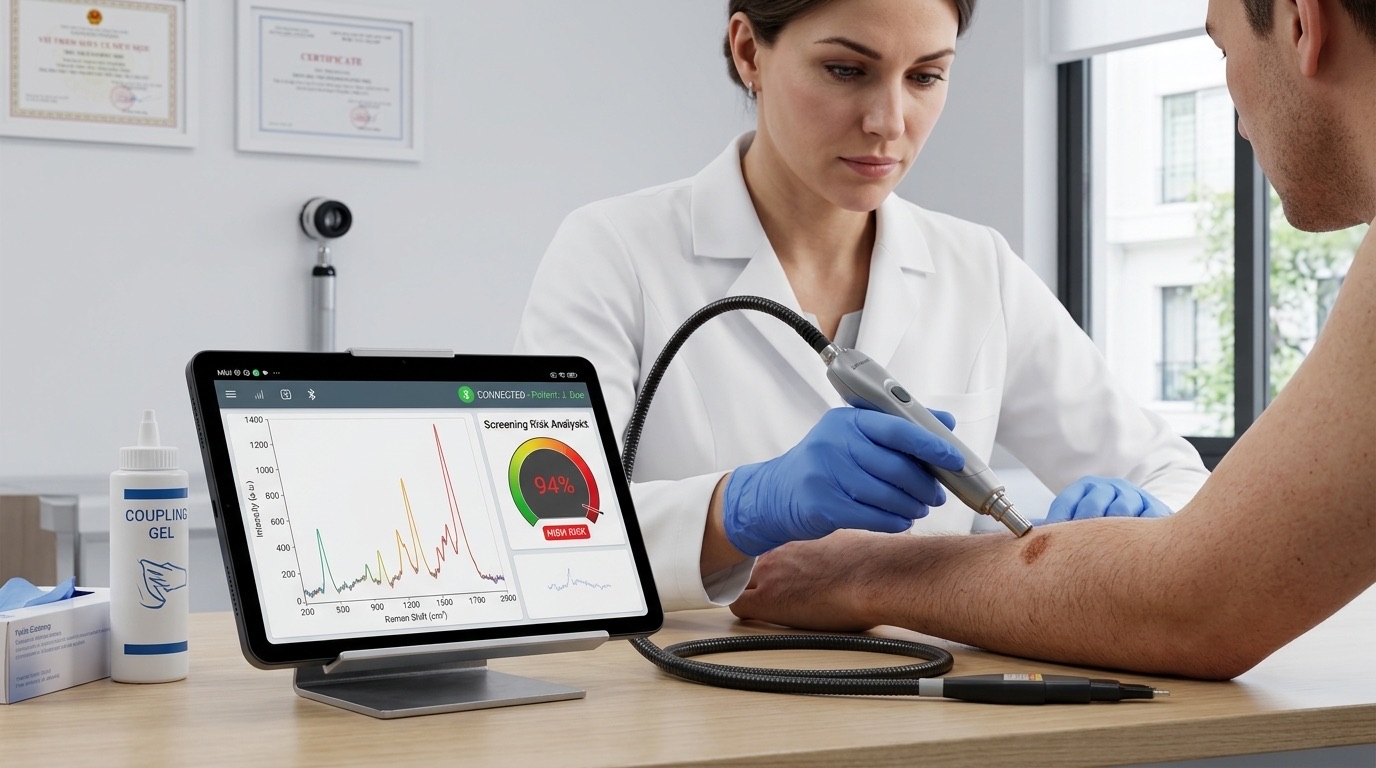
The Raman device captures a spectrum on the suspicious skin area in seconds, non-invasively.
AI analysis
The model processes the spectrum and returns a risk indicator with confidence.
Doctor confirms
Results pass through a physician review portal before becoming a clinical conclusion.
Follow-up
Measurement history & results sync across web and mobile apps.
One platform, three pieces
Raman device
Handheld (Bluetooth) and benchtop versions for clinics, capturing spectra at the point of care.
ZinMed app
Technicians measure on site; patients view results, reminders and connect with doctors.
Management platform
Manage patients, results, the physician review portal and audit logs.
ZinRaman-D1 — benchtop skin cancer screening device
A 785nm Raman spectroscopy device combined with AI, capturing spectra at the point of care with results in seconds — non-invasive.
See full technical specification →
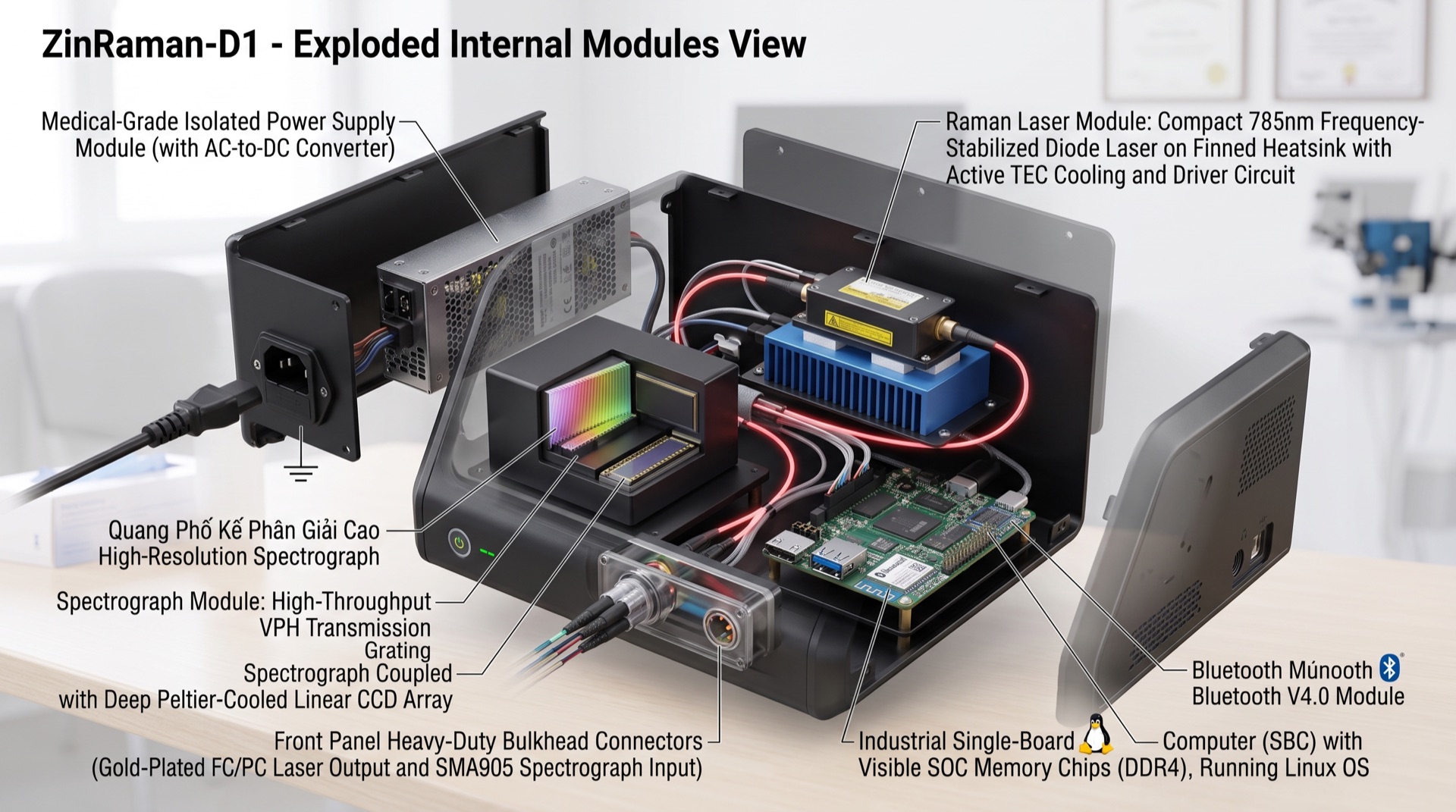

Compact · low-cost · made in Vietnam
ZinRaman-D1 aims to bring non-invasive screening to provincial and grassroots facilities — replacing bulky, expensive imported systems.
| Criteria | ZinRaman-D1 (prototype) |
| Technology | Raman spectroscopy 785nm + AI |
| Form factor | Compact benchtop |
| AI inference | Runs on-device, offline |
| Manufacturing | Domestic (Made in Vietnam) |
| Focus | Point-of-care screening, provincial/grassroots |
Strong research group “AI in Healthcare” — VNU
Bringing together experts in AI, biomedical electronics, physics and medicine from UET, International School and University of Science (VNU) with clinical specialists.
From skin cancer to a healthcare AI platform
Skin cancer is the starting point — where Raman + AI proves its value. ZinMed aims for a non-invasive screening platform across many diseases, bringing “health within reach” to everyone.
- ●Phase 1 — Skin cancer (VNU-level project, 2024–2026)
- ○Expansion — Diabetes & breast cancer
- ○Long term — Multi-disease medical AI platform, certified
Safety & compliance
From research to a certified product
Launch project QG.24.84
VNU approval · optical–electronic–mechanical design
ZinRaman-D1 prototype + ~1,200 spectra
≈500 clinical + 700 simulated · Samara University · 4-class AI + XAI
Clinical trials at provincial/central hospitals
Target: multi-center sensitivity/specificity validation
Certification & market authorization
Toward IEC 60825/60601 · multi-disease expansion
Join ZinMed to bring early screening closer
Medical facilities
Partner with us to trial and clinically evaluate this non-invasive screening tool.
Contact usResearch partners
Collaborate on clinical data, AI models, scientific publications.
Propose collaborationFrequently asked questions
Does AI replace the doctor?
No. Results are a screening/risk indicator; every clinical conclusion must be confirmed by a specialist.
Is the device safe?
Low-power laser, shielded in a sealed enclosure; designed toward IEC 60825 (laser safety) and IEC 60601 (medical electrical safety) — under evaluation.
How accurate is it?
Design target: 75–85% sensitivity/specificity on the model-development set. This is a research goal, not a clinically validated result.
Is it certified yet?
Not yet. The device is under research; we are building a QMS aligned to ISO 13485 (not yet certified) and preparing market-authorization documentation.
News & Research
Hoàn thiện cơ sở dữ liệu 1200 mẫu phổ Raman ung thư da
Bộ dữ liệu chuẩn 1200 mẫu (500 mẫu lâm sàng + 700 mẫu mô phỏng neo dữ liệu thật) làm nền huấn luyện & đánh giá mô hình AI 4 lớp.
Ra mắt kiến trúc ZinRaman-D1 — máy để bàn sàng lọc ung thư da
Nguyên mẫu ZinRaman-D1: hộp kín tích hợp laser 785nm, quang phổ kế StellarNet, máy tính nhúng và màn hình 15" cảm ứng — chẩn đoán tại chỗ trong vài giây.
Hợp tác công nghệ với nhóm Biophotonics — Đại học Samara (LB Nga)
ZinMed hợp tác nhóm GS. I. Bratchenko (ĐH Samara) — đơn vị làm chủ chẩn đoán ung thư da in vivo bằng Raman kết hợp tự huỳnh quang (autofluorescence).
Let's bring early screening closer
Are you a medical facility, investor or research partner? Connect with ZinMed.
hoangcd@zinmed.com